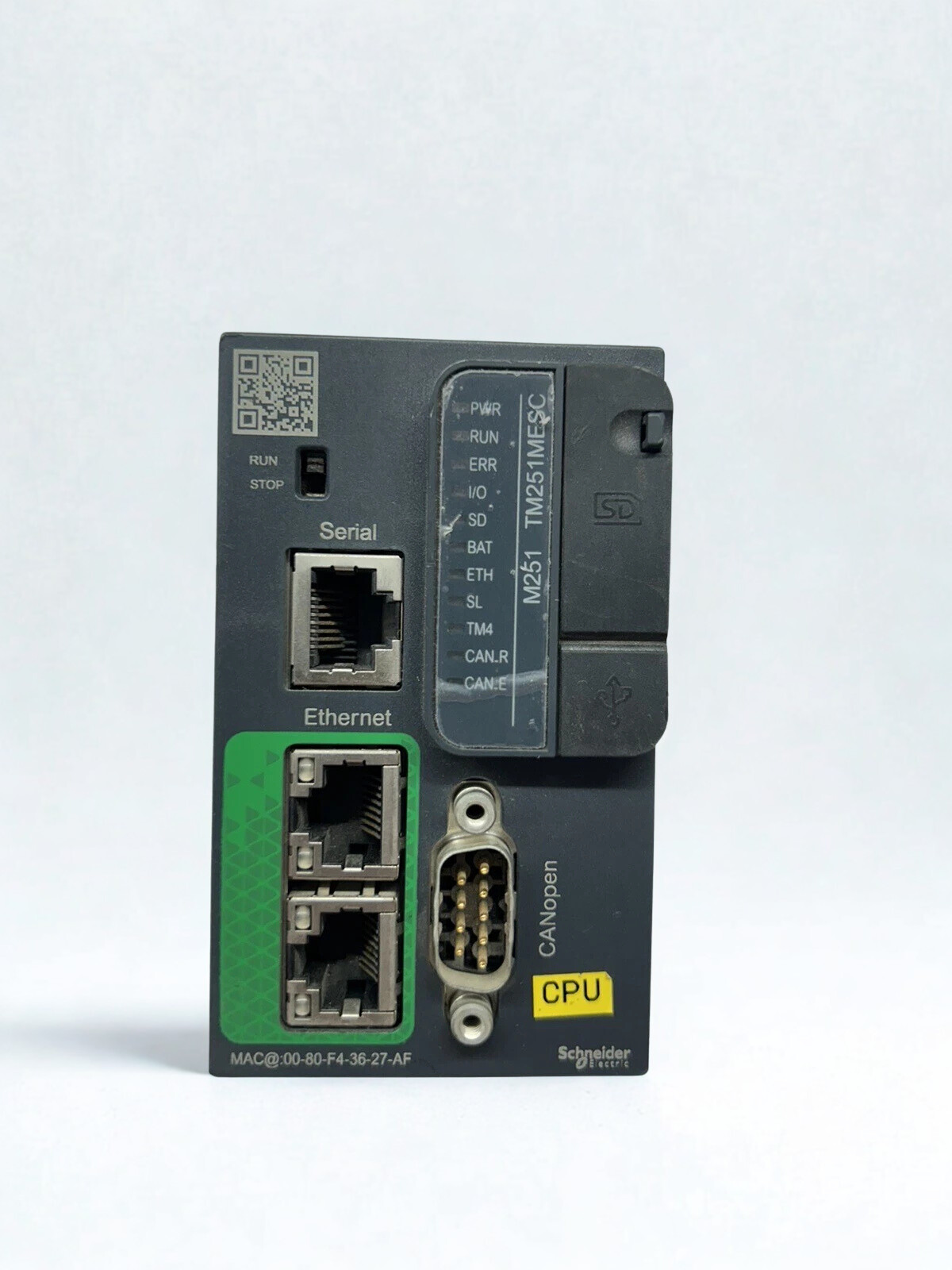
The Schneider Electric TM251MESC Modicon M251 Controller has built-in Ethernet and CAN connectivity and provides strong logic control for industrial automation. This small PLC is great for handling materials, packing, and marine applications since it can do a lot of things at once and connect to networks without any problems. It is optimized for efficiency and can do complicated jobs while taking up as little cabinet space as possible. Technical Specifications – Schneider Electric TM251MESC Parameter Value / Description Model TM251MESC – Modicon M251 logic controller Supply voltage 24 V DC (limits 20.4…28.8 V) Inrush current 50 A Power consumption 32.6…40.4 W (with maximum I/O expansion) Program memory 8 MB System memory (RAM) 64 MB Data backup memory 128 MB built‑in flash for user program backup I/O expansion capacity Up to 7 local modules / 14 remote modules Communication – Ethernet 2× RJ45 ports, 10BASE‑T/100BASE‑TX, copper up to 100 m Communication – CANopen 1× CANopen port (SUB‑D 9) Communication – Serial 1× RJ45 RS‑232/RS‑485, Modbus RTU/ASCII master/slave Communication – USB 1× USB mini‑B programming port (EcoStruxure Machine Expert) Embedded services Web server (WebVisu), FTP client/server, SNMP, SQL client, DHCP, email, SMS, OPC UA server, Modbus TCP client/server/slave, Ethernet/IP adapter Application structure 3 cyclic master tasks, 1 freewheeling task, 8 event tasks, 4 external event tasks Protection rating IP20 with protective cover in place Operating temperature −10…55 °C Relative humidity 10…95% non‑condensing Vibration resistance 3.5 mm (5…8.4 Hz), 3 g (8.4…150 Hz), rail or panel mounting Shock resistance 15 g for 11 ms Operating altitude 0…2000 m Dimensions (W × D × H) 54 × 95 × 90 mm Weight Approx. 0.22 kg Degree of pollution Pollution degree 2 Battery BR2032 lithium, non‑rechargeable, approx. 4‑year life Certifications / approvals CE, CSA, cULus, marine (LR, ABS, DNV, GL), UKCA, UL 508, ANSI/ISA 12.12.01 TM251MESC Key Features: -> A powerful, little PLC with 8 MB of application memory and 64 MB of RAM for tough machine control jobs. -> Two Ethernet ports with a built-in switch for line or ring topologies and flexible Modbus TCP/Ethernet/IP/OPC UA connections. -> A built-in CANopen network lets you control motion, drives, and smart devices from one controller. -> For advanced diagnostics and IIoT/Industry 4.0 integration, it has an integrated web server, FTP, SNMP, SQL client, email, and SMS services. -> The architecture can grow to handle up to 7 local and 14 distant I/O modules, making it perfect for modular machines. -> There are dedicated status LEDs for power, run, error, I/O, SD card, Ethernet, serial, TM4, and CANopen that provide you a lot of information. -> EcoStruxure Machine Expert programming that works with standard IEC 61131‑3 languages (LD, FBD, ST, SFC, IL) with a hardware Run/Stop switch. -> IP20 rating, wide temperature range, and great vibration/shock resistance make it a strong design for tough industrial settings. -> SD card slot for quick software downloads, data logging, and easy controller changes in the field. Connectivity and Communication Protocols With dual Ethernet 10/100BASE-TX ports, you can set up a Modbus TCP client/server/slave, an Ethernet/IP server, an OPC UA server, and a web server with WebVisu for remote monitoring. The SUB-D 9 connector for the CANopen (J1939) port offers high-speed fieldbus integration, making it great for marine and industrial networks. There are also other interfaces, such as: USB mini-B for programming with EcoStruxure Machine Expert. RJ45 serial port (RS232/RS485) for Modbus RTU and ASCII. Services including DHCP, FTP/SNMP/SQL clients, SMS/email, and Ethernet firmware upgrades. Status LEDs and Diagnostics Real-time diagnostics are available through comprehensive LED indicators, which include PWR (power), RUN (application status), ERR (internal errors), I/O (bus faults), SD (card access), BAT (battery), ETH (Ethernet/IP), SL (serial), TM4 (bus), and CAN-R/E (CANopen). These make it easier to fix problems in tough places like automation panels. Usage in Industry: Central machine controller for small, high-performance machines like those used for packaging, moving materials, and making textiles. Line control in distributed systems where several I/O islands, drives, and HMI panels talk to each other using Ethernet and CANopen. Integration node in OEM systems that need to link to SCADA, MES, or cloud platforms through TCP/IP, OPC UA, and web services. Using CANopen-based motors and actuators to control motion and position in conveyors, sorters, and assembly machines. Projects to upgrade panels and retrofit when a small PLC with a lot of communication possibilities has to fit into a small cabinet.